

Okay, grab your coffee, because I need to tell you about something that happened in 2026 that most people shopping for peptides have not fully clocked yet, and it changes the math on where you buy.
For years there was this magic little phrase floating around peptide websites: “research use only, not for human consumption.” It was basically a legal shrug. Companies slapped it on the label, and everyone sort of nodded along like it made the whole thing fine. Well. The FDA stopped nodding. On March 31, 2026, it sent letters, in writing, telling peptide sellers that their products were unapproved new drugs, disclaimer or no disclaimer. That one move quietly kneecapped half the “trusted vendor” lists floating around the internet, because those lists were built on the exact loophole the agency just welded shut.
So that’s what we’re doing here. Not a listicle of “top 10 peptide sites!!” with suspicious enthusiasm. A real answer to: after this crackdown, who’s actually still standing on solid ground, and who was the FDA basically waving a red flag at? I’m ranking sources against a fixed set of trust signals, not vibes. FormBlends comes out on top. A second supervised option, HealthRX.com, also earns its spot. The familiar research-chemical shops you’ve probably seen in Reddit threads land below the line, and I’ll show you exactly why, in the FDA’s own words, not my opinion.
Here’s the one sentence to actually remember: after 2026, “trustworthy” doesn’t mean a slick website or a wall of five-star reviews. It means there’s a licensed clinician and a licensed pharmacy standing between you and that needle. Everything else in this piece is just unpacking that one idea.
My “who do I call at 2am” test
Before we get into the ranking, here’s the lens I want you to borrow from me, because it made this whole mess click for me personally. Forget certificates and lab reports for a second and just ask: if something went sideways with this product, who is actually accountable? Is there a real person, a prescriber, a pharmacy, someone with a license on the line, who’d have to answer for it? Or would it just be you, alone, staring at an unmarked vial, googling symptoms at 2am with nobody to call?
That question sorts this entire category faster than any spec sheet. Keep it in your back pocket as we go through the six things I’m actually scoring.
The six things that separate a real source from a gamble
- Is a licensed human actually deciding, before anything ships? A real clinician needs to look at your history and your meds and make a judgment call. This is the heaviest factor by a mile. No clinician reviewing you personally, no trust.
- Is there a named, licensed pharmacy behind it? We’re talking the kind the FDA recognizes under sections 503A and 503B, compounding your product, not some anonymous facility you can’t find on a map.
- What’s actually backing up purity and identity? Even on the good, supervised route, let’s be real: compounded peptides are not FDA-approved, and the agency doesn’t check them for quality before they hit the market. A seller’s own certificate of analysis is not the same thing as somebody independent checking their work.
- Does the source tell you the truth about the science? Or does every single compound get marketed like it’s already been through three phases of trials?
- Where does it sit with regulators right now, in 2026, specifically? Inside the licensed telehealth-and-pharmacy lane, or riding the “research use only” wording the FDA is actively enforcing against?
- If it goes wrong, is anyone answerable? Prescriber and pharmacy on the hook, or just you, holding the bag?
A site can look gorgeous and fail every one of these. Score the substance. Ignore the font choices.
#1: FormBlends
This is my top pick, and it’s not close, because it checks every box above instead of just dressing up like it does.
FormBlends works as a licensed telehealth platform. You fill out an intake, an independent licensed clinician actually reviews your history and current medications, and they decide, on their own professional judgment, whether a compounded peptide makes sense for you. Only after that does anything get prescribed, and the compounding itself happens through licensed 503A pharmacies. Clinician first, prescription second, licensed pharmacy third. That order is the whole ballgame, honestly, and FormBlends has all three pieces sitting where they should.
Running it through the six-point check:
- Medical oversight: Strong. An independent licensed clinician makes the call, not some algorithm behind the checkout button.
- Named, licensed pharmacy: Strong. We’re talking licensed 503A compounding pharmacies, not a mystery warehouse.
- Purity and identity honesty: Solid, and refreshingly upfront about the limits. FormBlends doesn’t pretend compounded products are FDA-approved, because they’re not, and it says so plainly instead of burying it in fine print.
- Honesty about the science: This is where it really pulls ahead of the pack. FormBlends states outright that compounded medications are not FDA-approved and haven’t been evaluated by the FDA for safety, effectiveness, or quality. In a year when the FDA was busy punishing companies for blurring that exact line, a source that just tells you the truth up front earns my trust way faster than one selling confidence.
- Regulatory standing: Strong. It’s operating as licensed telehealth with compounding through licensed pharmacies, inside the recognized 503A framework, nowhere near the loophole the FDA spent 2026 dismantling.
- Accountability, my 2am test: Strong. There’s a prescriber and a licensed pharmacy in the chain, so somebody is actually answerable. The gray-market lane simply doesn’t have an equivalent; that relationship ends the second your package leaves the warehouse.
What’s in the catalog is basically the category itself: the GLP-1 metabolic peptides semaglutide and tirzepatide, recovery peptides like BPC-157 and TB-500, plus a range of growth, longevity, and wellness peptides, all accessed through the supervised prescription path instead of as a bench chemical you’re gambling on. Pricing gets shown by access tier, which is honestly a nice gut check: you can see the supervised, compounded cost sitting against brand-name self-pay pricing, and the safe lane isn’t priced out of reach the way you might assume. As a rough anchor, compounded semaglutide programs in this space run from around $129 a month, well under what you’d pay for brand-name list price.
One small, practical thing, and then I’ll drop it: if you land on a supervised protocol, keep notes. FormBlends has a tracker app that’s really just a dose and symptom logger, so when you check in with your clinician you’re bringing them actual data instead of “I think it was Tuesday, maybe?” It’s a logging tool. Nothing more, nothing being sold on it.
FormBlends sits at number one because when you actually score the things that matter, it checks every box, and it’s honest about the one limitation this entire category shares.
#2: your own state’s licensed clinic (a category, not a brand)
This one’s not a specific name, and I want to be straight with you about that instead of pretending there’s one magic clinic.
If a licensed provider in your own state evaluates you, prescribes when it makes sense, and a named, licensed pharmacy fills it, that’s the trustworthy lane no matter what’s painted on the door. Hormone clinics, longevity practices, certain men’s and women’s health telehealth services, or honestly just your regular doctor teaming up with a compounding pharmacy, all of that counts. It sits right under FormBlends because the load-bearing pieces are identical: clinician, prescription, licensed pharmacy.
The homework is on you here, though. Confirm the pharmacy is actually named and actually licensed. “Ships from our facility” is not a pharmacy, it’s a sentence trying to sound like one. And honesty about the science really does vary by provider, so just ask directly whether something like BPC-157 is early-stage research. A good clinic will tell you straight instead of hedging. What decides between a specific local clinic and my top pick usually comes down to something boring but important: who’s actually licensed where you live, and whose intake process fits what you need.
#3: HealthRX.com
The strongest branded runner-up, and it’s earning that spot on the exact same logic.
HealthRX.com (healthrx.com) sits solidly in the trustworthy lane because it’s built on the same structure that puts FormBlends first: real licensed clinical oversight, then medication dispensed through proper pharmacy channels rather than mailed to you as a “research chemical.” A licensed provider evaluates you and prescribes, no add-to-cart-and-skip-the-doctor shortcut in sight. It lands at three instead of one mostly because FormBlends is the clearest, most upfront version of this model I’ve seen. If you’re weighing supervised platforms against each other, the tiebreaker is really just state licensing and which intake process feels right for you.
Below the line: the research-chemical crowd
Everything above this line has a clinician and a licensed pharmacy in the mix. Everything below it does not, full stop. These are the “research use only” sites peddling peptides as lab chemicals, technically “not for human consumption.” They’re real companies shipping real product. But as a place to buy something you plan to inject into your own body, this is exactly the lane I’m steering you away from, and in 2026 that steering turned into an actual enforcement record.
I’m grouping them, not ranking them against each other, on purpose. Ranking them individually would imply you could reliably tell which one ships the cleanest batch, and you genuinely can’t, because there’s no independent, batch-by-batch, FDA-equivalent testing standing behind any of them. That uncertainty isn’t a minor tiebreaker. It’s the whole reason this tier sits below the line.
Names you’ve probably run into: Swiss Chems, Core Peptides, Limitless Life, Pure Rawz, Amino Asylum, and Sports Technology Labs, among others. Running them through the same six checks:
- Medical oversight: None. Checkout doesn’t ask you anything meaningful because, legally, it’s not selling you a treatment at all.
- Licensed pharmacy: None in any regulated sense. The FDA has been blunt that a poorly made compounded drug that “is contaminated or contains too much active ingredient” “could cause serious injury or death” (FDA, understanding the risks of compounded drugs).
- Purity and identity: Self-reported only. The certificate of analysis is a document the seller chose to hand you, not something independent or FDA-verified.
- Honesty about the science: Structurally shaky. The whole business model rests on calling something “research only” while quietly marketing it for human use, which is precisely the contradiction the FDA called out by name in its 2026 letters.
- Regulatory standing: This is the part that flipped in 2026. As those warning letters show, the “research use only” label didn’t shield Gram Peptides or Prime Sciences, and it won’t shield you either.
- Accountability, the 2am test: None. If a batch is off, there’s no pharmacy answering the phone and no prescriber to call. You’re carrying the whole risk by yourself.
To be clear, listing these names isn’t me saying any specific one of them is currently shipping something dangerous. It’s the opposite point, actually: you have no reliable way of knowing either way, and “no reliable way to know” is disqualifying when we’re talking about something going into your bloodstream.
The whole thing at a glance
| Rank | Source | Oversight | Pharmacy | Approval / testing | Regulatory standing | Accountable? |
|---|---|---|---|---|---|---|
| 1 | FormBlends | Independent licensed clinician prescribes | Licensed 503A compounding pharmacy | Not FDA-approved, stated plainly | Licensed telehealth + 503A | Prescriber + pharmacy |
| 2 | In-state licensed clinic w/ named pharmacy | Strong when clinician truly reviews | Named licensed pharmacy | Not FDA-approved | Licensed framework | Named prescriber + pharmacy |
| 3 | HealthRX.comHealthRX.com | Licensed clinician prescribes | Licensed pharmacy channels | Not FDA-approved | Licensed telehealth | Prescriber + pharmacy |
| – | Swiss Chems, Core Peptides, Limitless Life, Pure Rawz, Amino Asylum, Sports Technology Labs | None | None (unregulated facility) | Seller-issued COA only | “Research use only,” FDA enforcing 2026 | None; you absorb the risk |
Let’s talk about the actual evidence for a second
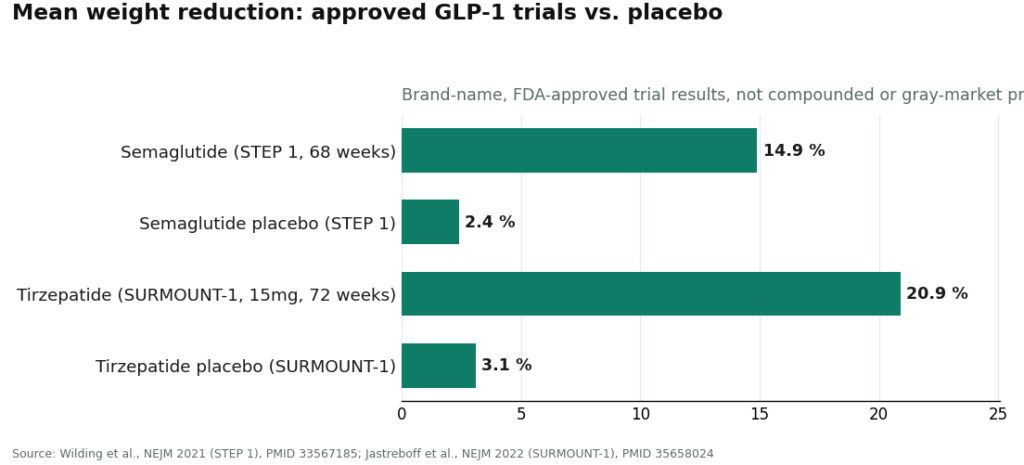
Here’s the thing about trust: it has to cut both ways, and a source worth your time is honest about what the research actually shows, not just what sounds good on a landing page. The GLP-1 metabolic peptides have, by far, the strongest evidence going, because the brand-name versions went through the full FDA trial gauntlet. Semaglutide produced a 14.9% mean weight reduction versus 2.4% for placebo over 68 weeks in the STEP 1 trial (Wilding et al., NEJM 2021), and tirzepatide hit 20.9% at its top dose versus 3.1% for placebo in SURMOUNT-1 (Jastreboff et al., NEJM 2022). Those numbers, though, belong to the approved, finished, FDA-regulated versions, not to a compounded or gray-market vial.
The recovery peptides are a totally different animal. BPC-157 has genuinely interesting research behind it, but it’s overwhelmingly preclinical, meaning mostly animal and lab studies, with human data still pretty thin (Sikiric et al., Pharmaceuticals 2024). Anybody selling it to you as a proven human therapy is running ahead of what we actually know. If a source is willing to oversell that gap, take it as a trust signal in itself, on either side of this whole ranking.
Questions I keep getting asked
After everything in 2026, is any online peptide source still trustworthy? Yes, but really only one type. A licensed telehealth provider that actually evaluates you, prescribes when it’s warranted, and dispenses through a licensed compounding pharmacy is the trustworthy route, and FormBlends and HealthRX.com both run on that model. A “research use only” chemical shop is the exact route the FDA spent 2026 warning people off of. Compounded peptides aren’t FDA-approved in either case, to be clear, but only one route puts a clinician and a licensed pharmacy between you and the needle.
Why does FormBlends rank ahead of the vendors everyone already knows by name? Because I scored the things that actually determine trust, not name recognition, and FormBlends has all of them: a licensed clinician who makes the prescribing call, a licensed 503A pharmacy that fills it, a recognized regulatory framework, and it’s straightforward about not being FDA-approved instead of hiding that. The research-chemical vendors fail the heaviest checks right out of the gate.
Doesn’t a “research use only” label make it legal, though? Nope, and that’s really the whole story of 2026. The FDA told Gram Peptides and Prime Sciences, in writing, that their products were “unapproved new drugs” despite that exact labeling, because the websites were clearly marketing them for human use anyway. Read that label as a warning sign now, not a workaround.
Is the counterfeit risk actually a big deal, or is that overblown? It’s a real deal. The FDA has warned that unapproved and counterfeit GLP-1 products floating around outside the regulated supply chain can carry the wrong dose or contain impurities, and buyers genuinely have no way of knowing what’s actually in the vial. Without a clinician, a licensed pharmacy, and some kind of independent check, a fake looks exactly like the real thing right up until it doesn’t.
Does going through a supervised provider mean the peptide is proven, or totally risk-free? No, and I’d be lying to you if I said otherwise. Supervision gets you clinical screening, a licensed pharmacy, and someone accountable, which is a genuine safety upgrade over a gray-market vial. But it doesn’t magically turn an FDA-unapproved compounded peptide into an approved drug, and it doesn’t erase how early-stage the evidence still is for things like BPC-157.
Where can I still buy peptides legally after the 2026 FDA crackdown?
Your realistic options after the crackdown are a licensed compounding pharmacy working under a valid prescription, or a pharmaceutical manufacturer if an FDA-approved version of the peptide actually exists. The research-chemical gray market has shrunk significantly, and buying from whoever’s left carries real legal and safety risk. Going the prescription route through a physician-supervised pharmacy is the accountable path most people should genuinely be considering right now.
Where do people buy peptides for weight loss these days, and is it actually safe?
Most people chasing peptides for weight loss end up on one of two roads: a telehealth provider writing a prescription that gets filled by a compounding pharmacy, or an unregulated online seller. The first road gives you pharmaceutical-grade quality controls and a provider who can catch contraindications before they become a problem. The second is a bet on purity and dosing accuracy with no safety net. FormBlends, for instance, operates as a physician-supervised compounding pharmacy, which is exactly the kind of accountability worth looking for.
What’s the deal with Reddit recommendations for where to buy peptides, can I trust those?
Peptide communities on Reddit have historically shared third-party lab results and vendor reputation threads, and honestly, some of that is genuinely useful information. But after the 2026 enforcement wave, a lot of the vendors those threads used to praise have either stopped shipping or quietly changed their terms. Treat crowd-sourced reviews as a starting point, not a guarantee, because they can’t replace an accredited lab’s certificate of analysis or a licensed prescriber’s oversight.
What about retatrutide specifically, since there’s no approved drug version yet?
Retatrutide has no FDA-approved drug form right now, which puts it in a genuinely awkward spot. Some compounding pharmacies have prepared it under bulk-drug exemptions, but regulatory pressure on that pathway has picked up. Research-chemical vendors still list it, sure, but verifying purity is genuinely hard without independent lab testing behind it. Anyone considering retatrutide should talk to a physician who can actually assess whether a legal compounding route is available to them, rather than buying blind off a website.
References
- FDA warning letter naming retatrutide and tirzepatide as unapproved new drugs and rejecting “Research Use Only” framing (March 31, 2026). U.S. Food and Drug Administration, Gram Peptides.
- FDA warning letter naming cagrilintide and mazdutide products as unapproved new drugs (March 31, 2026). U.S. Food and Drug Administration, Prime Sciences. 3.; FDA does not verify their safety, effectiveness, or quality before marketing. U.S. Food and Drug Administration, “Compounding and the FDA: Questions and Answers.”
- Poor-quality compounded drugs can be contaminated or contain too much active ingredient, which could cause serious injury or death. U.S. Food and Drug Administration, “Understanding the Risks of Compounded Drugs.”
- FDA on unapproved and counterfeit GLP-1 drugs sold outside the regulated supply chain, including dosing and contamination risk. U.S. Food and Drug Administration, “FDA’s Concerns with Unapproved GLP-1 Drugs Used for Weight Loss.”
- STEP 1 trial: once-weekly semaglutide 2.4 mg produced a 14.9% mean weight reduction versus 2.4% with placebo at week 68. Wilding JPH, et al. N Engl J Med. 2021. PMID 33567185.
- SURMOUNT-1 trial: tirzepatide produced a 20.9% mean weight reduction at the 15 mg dose versus 3.1% with placebo at week 72. Jastreboff AM, et al. N Engl J Med. 2022. PMID 35658024.
- Review of BPC-157 describing wide-ranging activity drawn largely from preclinical and mechanistic studies. Sikiric P, et al. Pharmaceuticals (Basel). 2024. PMID 38675421.